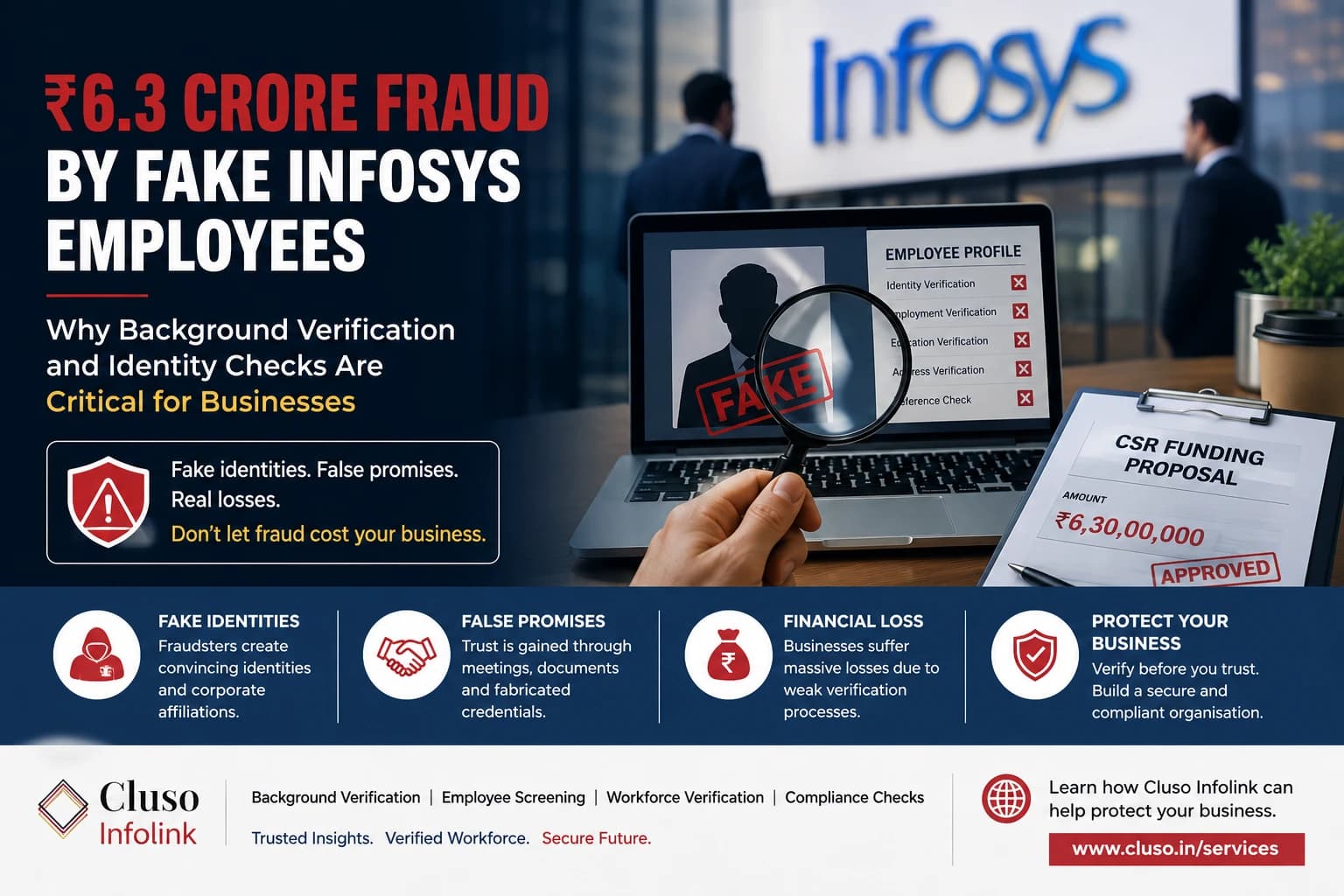
₹6.3 Crore Fraud by Fake Infosys Employees: Why Background Verification and Identity Checks Are Critical for Businesses
In today’s digital-first business environment, trust can no longer rely solely on appearances, business cards, email signatures, or claimed corporate affiliations. A recent high-profile fraud case in Karnataka has once again exposed how easily businesses can become victims when proper verification processes are ignored.
According to a report by NDTV, fraudsters allegedly posed as senior corporate social responsibility (CSR) executives from Infosys and cheated a Karnataka-based company of approximately ₹6.3 crore under the false promise of CSR funding and business opportunities. (ndtv.com)
The accused reportedly organised meetings, conducted field visits, used fake identities, introduced fabricated officials, and convinced the victim company to transfer large sums as “earnest money deposits” for CSR-linked projects. (ndtv.com)
This incident is more than just another fraud headline. It is a major warning sign for organisations across India.
The New Age of Corporate Fraud
Corporate fraud today is becoming increasingly sophisticated.
Fraudsters are no longer relying only on fake phone calls or forged documents. They now create:
Fake employee identities
Fraudulent company affiliations
Fabricated vendor relationships
False executive credentials
Fake project approvals
Impersonated corporate communication
In many cases, criminals exploit the reputation of trusted brands and large corporations to gain credibility quickly.
The Karnataka fraud case demonstrates how professional impersonation and weak verification practices can lead to devastating financial losses. (ndtv.com)
Why Background Verification Is No Longer Optional
Most organisations focus heavily on sales growth, hiring speed, partnerships, and operational expansion. However, many still fail to implement strong verification systems for:
Employees
Vendors
Consultants
Third-party partners
Contractual staff
Corporate representatives
This creates major security and compliance gaps.
Background verification is no longer just an HR formality. It has become a critical business protection strategy.
Businesses today increasingly rely on professional Background Verification Services to reduce hiring risks, verify workforce authenticity, and strengthen compliance processes.
The Hidden Risks Businesses Often Ignore
Cases like this reveal how businesses can be vulnerable to:
Fake employee impersonation
Vendor fraud
CSR and procurement scams
Forged credentials
Financial manipulation
Insider collusion
Identity fraud
Compliance failures
A single fraudulent interaction can result in:
Massive financial losses
Legal complications
Reputational damage
Operational disruption
Loss of stakeholder trust
For growing organisations, startups, enterprises, NGOs, and institutions handling large transactions, verification failures can become catastrophic.
Why Companies Must Verify Before They Trust
Businesses should never rely solely on:
Email domains
LinkedIn profiles
Visiting cards
Corporate introductions
Verbal claims
WhatsApp communication
Professional fraudsters are increasingly skilled at creating highly convincing identities.
Modern verification processes should include:
Identity verification
Employment verification
Corporate affiliation validation
Vendor due diligence
Reference verification
Digital footprint checks
Compliance screening
Verification should happen before:
Financial transactions
Vendor onboarding
Partnership agreements
Sensitive access approvals
Recruitment decisions
Companies implementing structured Employee Background Screening frameworks are significantly better equipped to detect red flags before they become serious business risks.
The Growing Importance of Workforce and Vendor Screening
As businesses digitise operations and expand remotely, the risk landscape is evolving rapidly.
Today’s organisations require:
Faster verification systems
Technology-driven screening
Real-time validation workflows
Continuous compliance monitoring
Risk-based verification models
Companies that implement structured verification frameworks are significantly better equipped to:
Prevent fraud
Reduce hiring risks
Protect financial operations
Improve compliance
Build trusted ecosystems
For organisations hiring at scale, advanced Workforce Verification Solutions can help streamline onboarding while maintaining workforce integrity and compliance.
Fraud Prevention Starts with Verification
The Karnataka ₹6.3 crore fake CSR fraud case is a reminder that trust without verification can become an expensive business mistake. (ndtv.com)
In an environment where fake identities, forged documents, and impersonation scams are increasing, businesses must adopt a “verify first” approach across hiring, partnerships, vendors, and financial transactions.
At Cluso Infolink Pvt. Ltd., we believe secure businesses are built on trusted verification processes. From employee screening to workforce verification and compliance-focused background checks, organisations today need stronger safeguards to protect their people, operations, and reputation.
Because in today’s world, trust must be verified.